
What the between-terms rule actually excludes
Under FUTA §3304(a)(6)(A), states must deny benefits based on certain educational employment during breaks between academic years or terms, and during vacation or holiday recess within a term, when the statutory contract or reasonable-assurance test is met. The federal denial is mandatory for instructional, research, and principal-administrative services. States have an option, within federal limits, to apply a parallel denial to nonprofessional school services and some services performed for schools by other employers. State law controls the details and may adopt stricter tests for nonprofessional workers.
This is a rule about whether particular school-service wages can support benefits for the break, not an automatic ruling that a worker can never receive unemployment. Wages from a non-school employer or from education work without a qualifying assurance may still matter to base-period eligibility, depending on state law. Report all work and wages accurately and let the state agency determine the claim.
Separate three questions when you read a denial: which employer's wages are affected, which weeks the between-terms rule covers, and whether other wages can establish a claim under state law. New York, for example, says school wages may be excluded for a defined period while non-school base-period wages can still be considered. That is a state example, not a nationwide formula.

How the state tests an offer of future work
The Department of Labor's active guidance says the state first checks three prerequisites: the offer may be written, oral, or implied but must be genuine and made by someone with authority to offer the job; the next-period work must be in the same professional or nonprofessional capacity as the prior work; and the offered job must not pay considerably less. DOL interprets the last test as at least 90% of the amount earned in the prior academic period (or corresponding term for someone who does not work successive terms). A label on a district letter does not by itself satisfy these tests.
If the prerequisites are met, the agency evaluates whether work is actually available. It considers all relevant circumstances, including contingencies, prior assignments, enrollment, funding, course offerings, seniority, and the employer's history. A contingency the employer controls, such as whether it chooses to offer a course or how it allocates available funds, can defeat reasonable assurance. A contingency outside its control is assessed for how likely it is to be met. The state agency, not the district, makes this determination.
Illustrative pay comparison: assume your prior academic-period earnings were $60,000 and an authorized offer lists $54,000 for the next comparable period. The calculation is $54,000 divided by $60,000, or 90%. Under DOL's guidance, that reaches the federal economic prerequisite. It does not settle the claim: the capacity, good-faith offer, likely availability, other legal tests, and state rules still need review.
Compare like with like. Record the periods used, expected hours, duties, pay basis, and benefits in the old and new roles. If one job is a school-year salary and the other is hourly or contingent, ask the state agency what records it uses for the comparison. Do not treat a 90% calculation as a promise that benefits will be approved.

Why staff category and employer matter
The law distinguishes professional school services from other work, and state adoption of the optional nonprofessional denial varies. Job titles alone do not decide capacity: the agency looks at the actual duties. Whether you work directly for the district, an educational service agency, or a private contractor can also change which statutory clause and state law apply. A cafeteria worker employed by a vendor, for example, should not assume the district's staff notice automatically governs that separate employment relationship.
Substitute and per-diem work is not automatically exempt or automatically covered. The agency examines whether the offer is genuine, whether future services are in the same capacity, the expected economic conditions, and the likelihood that work will be available. State examples differ: New York describes when substitute-pool placement can be reasonable assurance, while Pennsylvania explains how it distinguishes employee categories and decides each claim. Check your own state agency's current page and the exact employer and assignment.
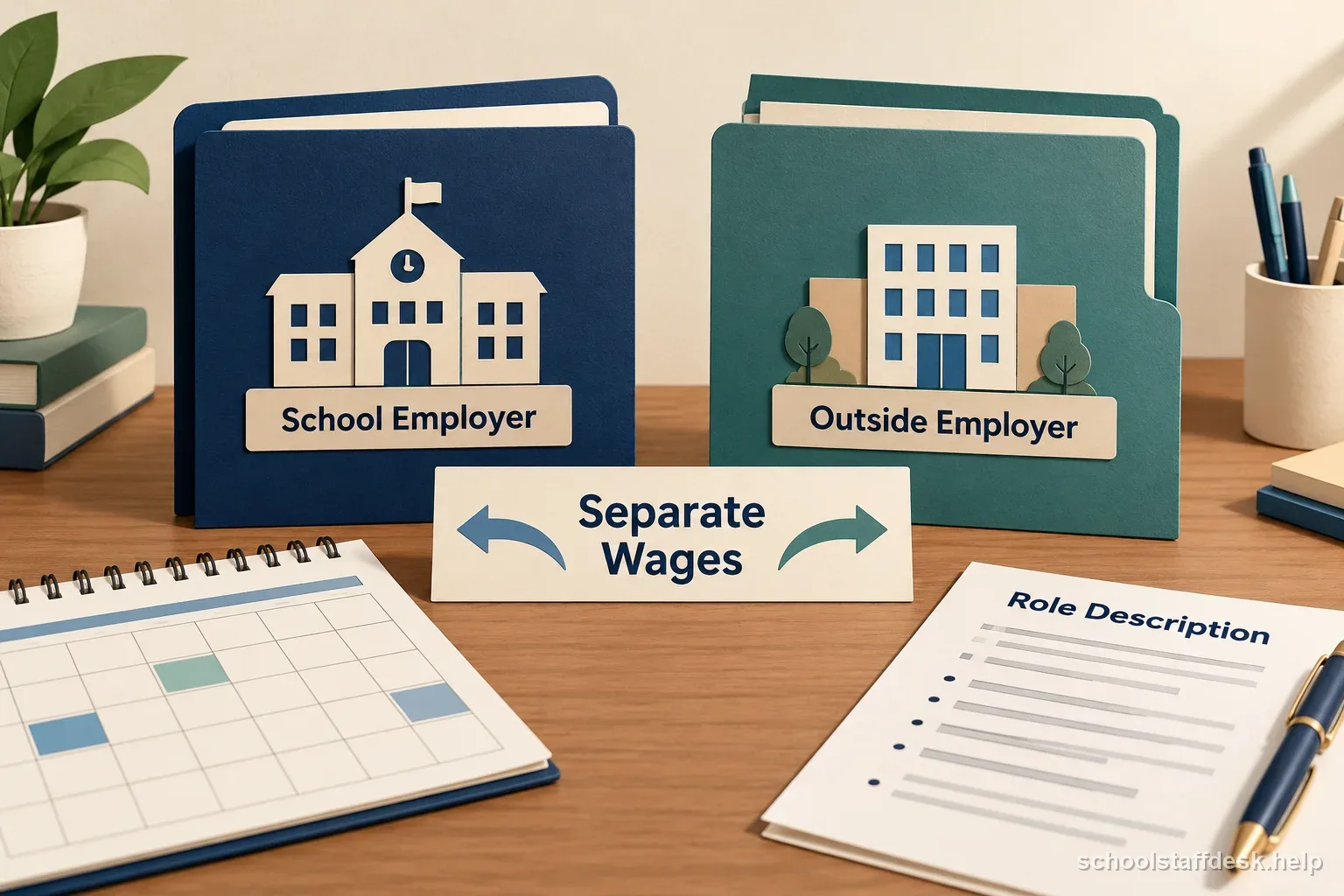
Make a separate row for each employer. For example, if you earned $200 a week from a non-school weekend job for 24 weeks, the arithmetic is $200 × 24 = $4,800 in reported non-school wages. That does not establish a benefit amount or guarantee a claim. It gives the agency a complete wage record to test against that state's base period and monetary rules.
If a staffing company pays you to work inside a school, identify the company shown on your pay statement and the entity that hired you. New York says its school-wage rule does not affect a worker who is employed by a private vendor rather than the school itself. Other states may frame coverage differently, so verify the state rule and do not infer the answer from the building where you work.
Evidence to collect before the state reviews an offer
| Question | Useful record | What it helps clarify |
|---|---|---|
| Who made the offer? | Letter, email, or dated notes | Authority and genuine intent |
| Is the work similar? | Prior and proposed duty lists | Professional or nonprofessional capacity |
| Are terms comparable? | Hours, pay, and benefit records | Economic conditions across terms |
| Is work likely? | Contingencies and assignment history | Availability and employer control |
| What wages remain? | Pay records from every employer | Possible non-school base-period wages |
- Gather the work offer or noticeKeep what the district actually communicated.
- File with the state agencyUse the state process rather than deciding eligibility yourself.
- Compare offer and actual workShare duties, capacity, earnings, contingencies, and employer assignment history.
- Certify and preserve review rightsContinue state-required weekly certifications and follow the decision's appeal deadline.
What to do when a break begins or a claim is denied
If you are unemployed, file with the state agency promptly instead of deciding on your own that the school-wage rule bars a claim. Describe each employer, the dates and duties worked, the scheduled break, any future offer or assurance, and other base-period work. Follow the agency's weekly certification and availability rules while it reviews the claim; an employer's notice is evidence, not the agency's final eligibility decision.
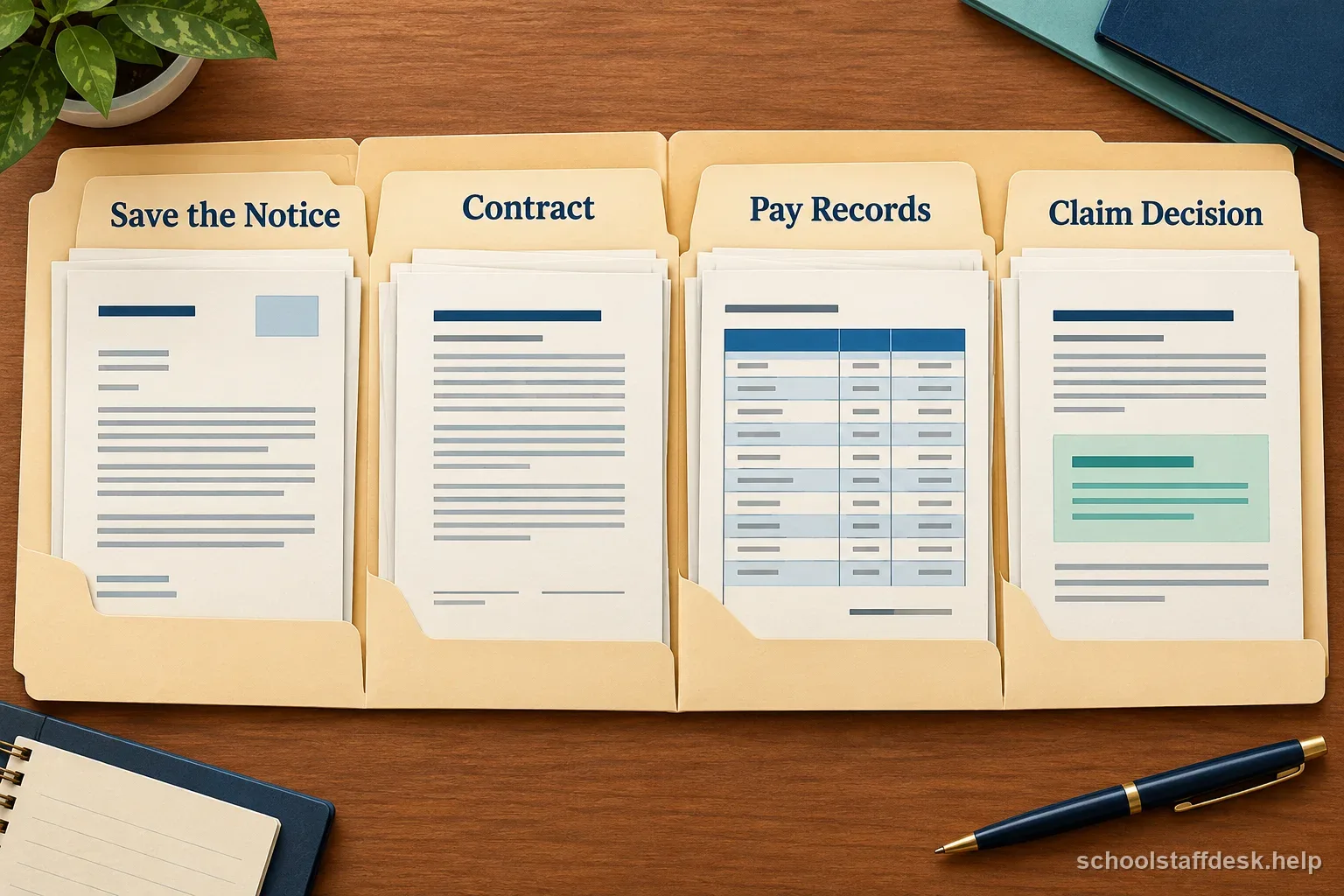
If the agency denies benefits, read the determination and appeal instructions immediately. Deadlines and review steps are state-specific. Keep the assurance notice, contracts, assignment history, pay and hours information, relevant communications, and the agency decision. A union, legal-aid service, or unemployment attorney may help you identify which federal test or state provision applies.
A second worked example: suppose you have $4,800 in wages from a separate employer during the relevant base period and a school employer's wages are disputed. List both employers and provide the pay records. The agency checks whether the $4,800 and any other included wages meet state monetary rules; this example intentionally does not predict a weekly benefit or eligibility result.

| Record | May support assurance | Still needs review |
|---|---|---|
| Firm offer | Authorized role and dates | Capacity, pay, and state rules |
| Open contingency | Assignment history | Who controls the condition |
| Outside employer | Separate wage records | Base-period requirements |
How a layoff or non-renewal changes the facts
A reduction-in-force or nonrenewal notice may show that no next-period job is available, but it does not decide every issue by itself. The offer, actual work category, timing, other education employers, base-period wages, and state rules still matter. If your assignment is changed, pay or hours fall, or return depends on a decision the employer controls, tell the agency and provide the documents so it can apply the test. A probationary nonrenewal notice has a separate state and contract review route.
Distinguish a customary school recess from a layoff or job separation and describe what happened accurately on the claim. Keep the RIF/nonrenewal notice and any return offer. If an assurance later fails, contact the agency promptly and ask what to do about any weeks already claimed. Federal rules provide different retroactive treatment by employee category, and state procedures still apply; do not assume every worker can recover every earlier week. For substitutes weighing summer unemployment, see the guide to substitute unemployment benefits between terms.
For a practical record of classroom duties and written terms in an extended role, see the guide to the long-term substitute assignment. If your position was eliminated or your contract was not renewed, compare the notice with the separate guide to probationary teacher nonrenewal deadlines. Those guides cover adjacent questions; this page focuses on the unemployment claim and the school's return offer.
Before you call, put the timeline on one page: last day worked, break start, date the offer arrived, any change in duties or pay, and the agency filing date. Add the contact's name and the documents you sent. A clear timeline helps you describe the issue consistently without guessing which legal test the agency will apply.
Sources used for this guide
- New York State Department of Labor — Unemployment Insurance Rules for Teachers and School Workers
- U.S. Department of Labor — UIPL 05-17: Contract and Reasonable Assurance
- New Jersey Department of Labor — School employers and employee eligibility
- Pennsylvania Department of Labor and Industry — School Reasonable Assurance FAQs
Rules can change. Use these sources as a starting point and confirm any state, district, student-plan, employment, licensing, or retirement requirement with the agency or team that governs your situation.
Questions school staff ask about this situation
Can school staff collect unemployment during summer break?
The rule may bar benefits based on school wages for certain between-term or recess weeks when a qualifying contract or reasonable assurance exists. It does not automatically bar benefits based on every other wage source or decide all state eligibility requirements.
Does the reasonable assurance rule only apply to teachers?
It depends on the service category, employer, and state law. The federal denial is mandatory for instructional, research, and principal-administrative services; states may apply a similar denial to nonprofessional school work and some services performed for schools by other employers.
What if my district didn't clearly tell me I was returning?
The offer may be written, oral, or implied, but it must be genuine and from someone authorized to offer the work. The state also tests capacity, earnings, contingencies, and whether a job is actually likely to be available. File a claim and let the agency assess the facts.
Does the rule apply the same way to substitute teachers?
Not automatically. The agency applies the genuine-offer, same-capacity, earnings, and job-availability tests to the substitute assignment and state law. Check the state agency's current guidance for substitute and per-diem workers.
Who decides whether reasonable assurance actually existed in a disputed case?
The state unemployment agency decides eligibility. A school notice is evidence, but it does not replace the agency's review of duties, employer, pay, contingencies, other wages, and state law.